
The Lab · Filipino Martial Arts
One System.
Every Range.
Filipino Martial Arts is not a style — it's an operating system. Weapon, empty hand, kicks, clinch — all built from the same core mechanics.
Weapon
First.
The Inverted Approach
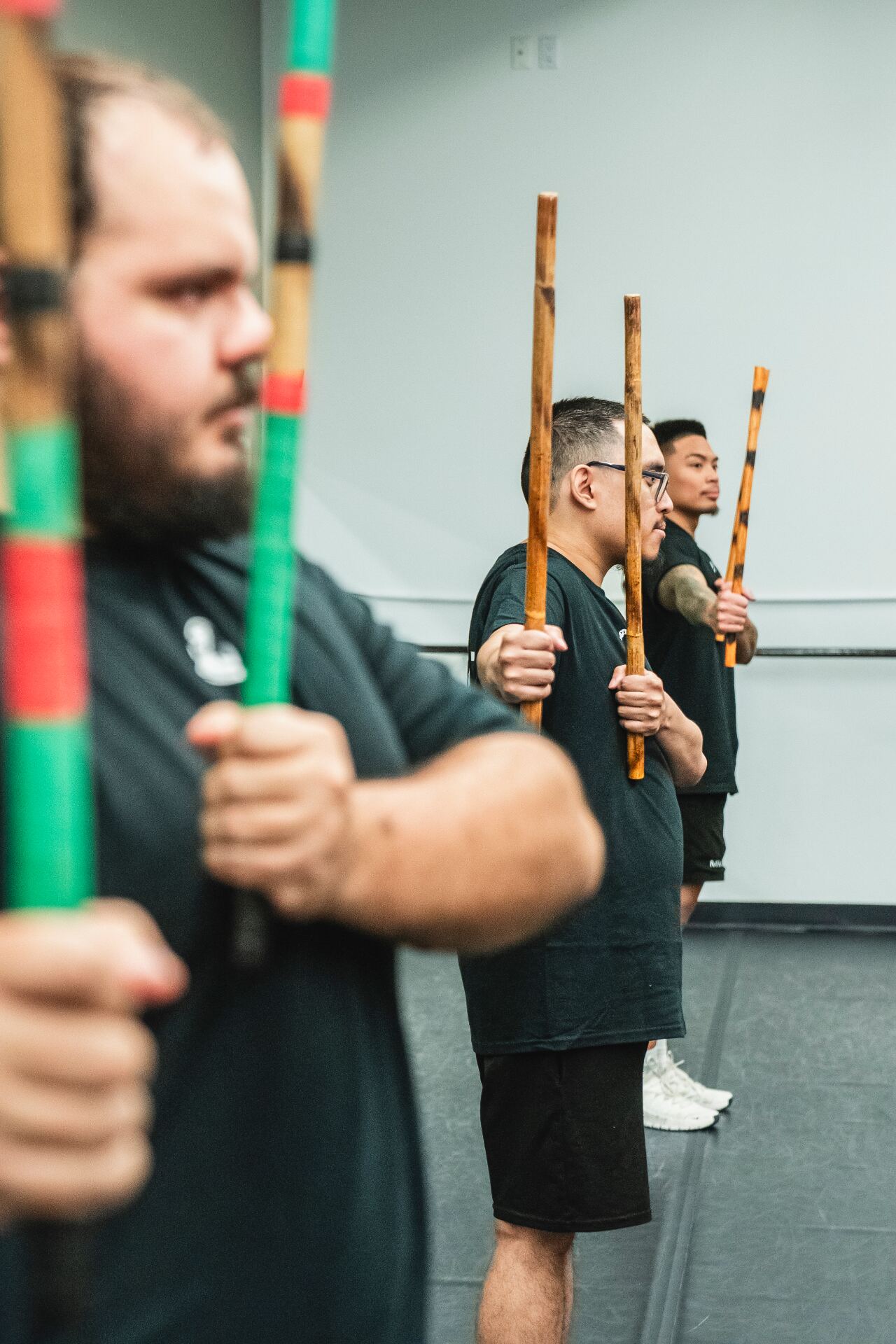
The weapons-first cognitive inversion. You start with the stick, because the stick exposes every flaw — your timing, your footwork, your structure, your awareness — instantly.
Once those mechanics live in your body, they transfer. The same angle that lands a strike with a stick lands a punch, a kick, or sets up a clinch entry.
It's also why we built Combat Lab around this system. There's no shortcut to body intelligence — but there's a faster path, and this is it.
The Disciplines
Full FMA Matrix
[AR-NIS]
Arnis
Single and double stick, the gateway to the entire system. Builds angles, footwork, and the timing that translates everywhere else. Categorized into 4 main types: Blunt/impact (sticks, hammers), Bladed (knives, machetes), Blexible (chains, belts), and Projectile (coins, throwing knives) — as well as defending against them with empty hands. At Combat Lab, we teach the Burokil Alambra Arnis De Mano system (B.A.A.D).
[PA-NAN-TU-KAN]
Panantukan
Filipino dirty boxing. Empty-hand expression of the blade — angled entries, limb destructions, off-line counters. Incorporates elbows, eye gouges, and other close-range techniques beyond punching — earning it the reputation of "dirty fighting."
[PA-NAN-DYA-KAN]
Panandyakan
Filipino kicking — low-line, deceptive, set up from the hands. Built to break structure, not to win points. Targeting thighs, knees, shins, and feet. Leg sweeping techniques are also incorporated.
[SI-KA-RAN]
Sikaran
The Filipino art of high-line kicking. This is the sport martial arts aspect of FMA that deploys high kicks and emphasizes the spin kick (called the biakid).
[DU-MOG]
Dumog
Filipino-style grappling. The main concept of moving an opponent from point A (stand-up) to point B (ground) using elbows, knees, forearms, and both large and small joint manipulation.
See It On The Floor
Reading about FMA only goes so far. Come try for yourself.